Is Reading or Reading/playing Music Better for Brain Function
Abstract
What is music and why do people call back it is important for learning? Musical sounds fill up our lives: from the music you share online to the songs playing in shops and restaurants, we are rarely far from music. Playing music gives the brain a multisensory "conditioning" that can strengthen memory, help us pay attention, and perhaps even improve reading ability. In this article, nosotros highlight how diverse encephalon functions, including hearing, sight, movement, and social sensation, are impacted by music training. You exercise not have to be a Mozart to get the encephalon benefit of playing music, considering music is then accessible and is more than than just songs. Whenever y'all communicate without words (the way you say something instead of what you say) you lot are engaging in musical behavior. In this article, we explore research on learning and music to help united states empathize why music promotes brain development and how music can be a central role of our lives, in and out of the classroom.
Heed the Melody
What is music and why do people remember it is of import for learning? While people of every culture around the world brand something that could be called music, not so many of them requite it a name or think of it as separate from other activities, like dance or storytelling [1]. Because of this, we can simply define music in a general manner, as a form of communication through sound. Different speech, however, music is non generally considered semantic . This means that music does not apply words to explicate things. Think how difficult it would be to say something relatively simple similar, "your left shoe is untied," using only melody and rhythm . At the same time, music can convey profound emotions that would be difficult to describe in words. In addition to music being an art form, whatsoever course of communication is partly musical and can be said to have musicality . Think of the different means that you might say "huh." Each of those ways communicates something different. That is musicality. It is not a musical performance, but a musical aspect of communication. While not everyone is a primary of the violin, anybody is a master of their own communication fashion.
At first, some scientists thought that the brain could benefit simply by listening to music. They showed that people'due south scores on IQ tests improved when they listened to classical music by Mozart [two]. This led people to believe that listening to music makes you smarter. Merely this was an oversimplification and an overstatement of the results. Subsequent studies showed that listening to music does not actually brand you smarter, simply rather raises your level of enjoyment and decreases your feelings of stress, which sometimes effect in amend focus and improved exam scores. This means that, while music in your abode or classroom would not automatically improve your operation, it could be useful to help you to focus on a new task or in situations when increased attention and decreased stress are necessary. Further, just listening to music may have a different, or perhaps smaller, effect than actually playing music. This is much the same as the way that playing sports will meliorate your concrete condition more than than simply watching sports. Therefore, the focusing power of music could exist amplified past playing forth.
Music for Brain Ability
Just similar your muscles, your brain gets stronger the more y'all practise it. The procedure of changing the brain through our experiences is called neural plasticity , because the brain is easily shaped, like plastic. Scientists measure neural plasticity with special brain-imaging techniques, similar magnetic resonance imaging (MRI) or electroencephalogram (EEG), to find out exactly how playing music changes the way our brains piece of work. Inquiry with these machines, as well every bit studying the brains of people who accept died, shows that auditory (hearing), visual (sight), and motor (movement) areas of the encephalon are specialized in practiced musicians [three]. The specialization includes not only increased size of each brain surface area, just also the style each area functions. The scientific discipline tells us that music is so much more than just a source of entertainment; information technology is an of import part of our lifetime of learning. Hither are some of the important things that happen in the encephalon when nosotros play music (for review, run into Zatorre [four]):
Auditory: The auditory organization processes sound more effectively afterwards musical training. People tin can detect smaller differences in frequency (the number of audio waves per second), making both speech and music easier to hear [five].
Motor: Brain areas that control instrument-related muscles and body parts (such every bit the fingers, the mouth, etc.) abound in size. More neurons in the brain are devoted to fine-tuning muscle motility in these areas.
Reading: Studies prove that amend musical ability is related to higher reading scores, suggesting a link between how well nosotros hear speech and how well we tin map speech sounds to messages.
Socio-emotional awareness: Playing music together can enhance socio-emotional awareness, which is the ability identify, manage, and limited emotions constructively. A good example of this is that very young children are more than likely to collaborate positively with people they play music with.
Making the Musical Connection
How can music alter anything other than what you hear? The reason music tin can accomplish so many parts of the brain is that the auditory system is highly interconnected with other sensory areas [half-dozen] (Figure 1). Think of your earliest schoolhouse days and you lot volition probably remember singing songs. Many of us still sing the alphabet song when trying to remember the position of a given letter. If you exercise not believe us, what letter is 4 letters subsequently "K"? Now tell usa you lot did not hear the alphabet song in your listen as you lot looked for the answer! Songs, with repetitive melodies and rhythms, aid us memorize lists, stories, and even processes.
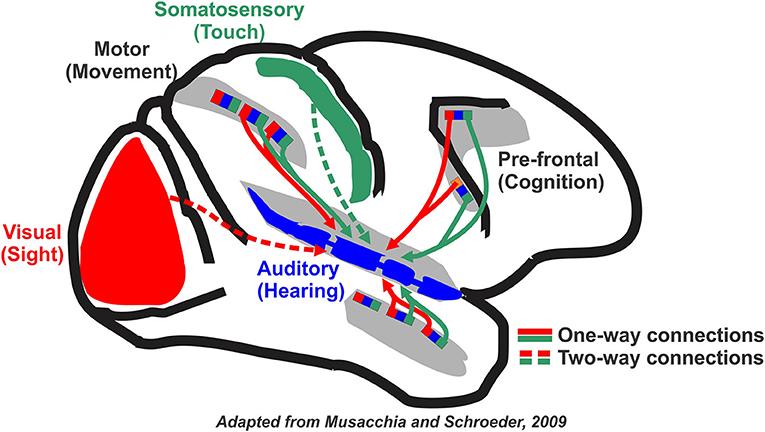
- Figure ane - Other sensory areas of the encephalon provide input to the auditory (hearing, in blue) area.
- Multisensory areas, such as the pre-frontal cortex (cognition), motor cortex (movement), and circuitous auditory cortex are shown in gray and contain small boxes colored to show the senses they interact with. Stiff connections to and from auditory and visual areas are considered to exist 2-way highways, because sensory information is shared betwixt brain areas in both directions (dashed orange lines). Similarly, somatosensory (touch) areas are shown in green and likewise take two-way connections that share information. Adapted from Musacchia and Schoreder [6].
Figure 1 shows the pattern of connections between the main auditory area in the encephalon and the other areas of sensation and perception. When nosotros larn to play music, our senses actively interact, including sight, bear upon, hearing, balance, motion, and proprioception (body sensation). In that location are ii things that brand music fairly unique in this process. Kickoff, when you play music, yous are using all of your senses. For example, y'all feel the instrument in your hands, hear the sounds you play and see the notes on the music sail. Since each different type of sensory data reaches your brain at a different time, your brain must work to synchronize all of this information. 2nd, when playing music, things happen at different speeds and fourth dimension scales and must line up precisely. For example, a guitarist must know where s/he is on a vanquish, in a rhythm, in a melody, in a song, and in a concert, precisely lining up all of these things. While our understanding of how the brain keeps track of all these things remains unclear, it is likely that at that place are different timekeeping mechanisms ("clocks") for dissimilar timescales (speeds). Some of our research is based on the idea that synchronization between these brain "clocks" could help us analyze other sounds streams like speech.
A Lifetime of Music
Music is also a style that we limited our identities: the music we play, or even listen to, can exist a fashion of telling the world, our peers, our parents, and our friends something about who we are. In cultures that do non employ writing, singers frequently hold an of import place in social club, considering they memorize important things like history and family relationships. While musical expression of identity is usually positive, there have been times when ane group of people institute another group'south music threatening, or fifty-fifty dangerous [seven]. For example, in the late 1980s rap music artists were arrested for performances that authorities idea were hostile and disrespectful.
While yous might think of singing a song or playing an instrument every bit a special activity that you lot practice but at sure times, you should likewise notice that music and musical sounds fill up our lives. Music is played on speakers and sometimes played alive, and we can hear music in most public places, on buses, in elevators, and in restaurants. Many of united states listen to music through our phones or in our cars as well. Our lives are truly full of music, and and then our human relationship to music can have a big effect on a lifetime of learning.
Glossary
Semantic: ↑ Relating to meaning in language or logic.
Melody: ↑ A sequence of single notes that is musically satisfying.
Rhythm: ↑ A potent, regular, repeated design of move or audio.
Musicality: ↑ Musical talent or sensitivity.
IQ Examination: ↑ Intelligence quotient, a standard measure of an individual'due south intelligence level based on psychological tests.
Neural Plasticity: ↑ The capacity of the nervous system to alter itself in response to experience or deprivation.
Conflict of Interest
The authors declare that the enquiry was conducted in the absenteeism of any commercial or financial relationships that could exist construed as a potential conflict of involvement.
Acknowledgments
Nosotros would like to thank those who assisted in the translation of the articles in this Drove to make them more accessible to kids outside English-speaking countries, and for the Jacobs Foundation for providing the funds necessary to interpret the manufactures. For this article, nosotros would especially similar to thank Nienke van Atteveldt and Sabine Peters for the Dutch translation.
References
[i] ↑ Merriam, A. P., and Merriam, V. 1964. The Anthropology of Music. Evanston, IL: Northwestern University Printing.
[2] ↑ Rauscher, F. H., Shaw, Thousand. L., and Ky, K. North. 1995. Listening to Mozart enhances spatial-temporal reasoning: towards a neurophysiological basis. Neurosci. Lett. 185:44–7
[3] ↑ Schlaug, G. 2009. "Music, musicians, and encephalon plasticity," in Oxford Handbook of Music Psychology, eds S. Hallam, I. Cantankerous and M. Thaut (Oxford: Oxford University Press), 197–207.
[4] ↑ Zatorre, R. J. 2003. Music and the brain. Ann. Due north. Y. Acad. Sci. 999:four–14. doi: 10.1196/annals.1284.001
[5] ↑ Musacchia, G., Sams, M., Skoe, E., and Kraus, N. 2007. Musicians accept enhanced subcortical auditory and audiovisual processing of speech and music. Proc. Natl. Acad. Sci. UsA. 104:15894–viii. doi: x.1073/pnas.0701498104
[half dozen] ↑ Musacchia, G., and Schroeder, C. East. 2009. Neuronal mechanisms, response dynamics and perceptual functions of multisensory interactions in auditory cortex. Hear Res. 258:72–9. doi: x.1016/j.heares.2009.06.018
[7] ↑ Binder, A. 1993. Constructing racial rhetoric: media depictions of impairment in heavy metal and rap music. Am. Sociol. Rev. 58:753–67.
Source: https://kids.frontiersin.org/articles/10.3389/frym.2020.00081
0 Response to "Is Reading or Reading/playing Music Better for Brain Function"
ارسال یک نظر